
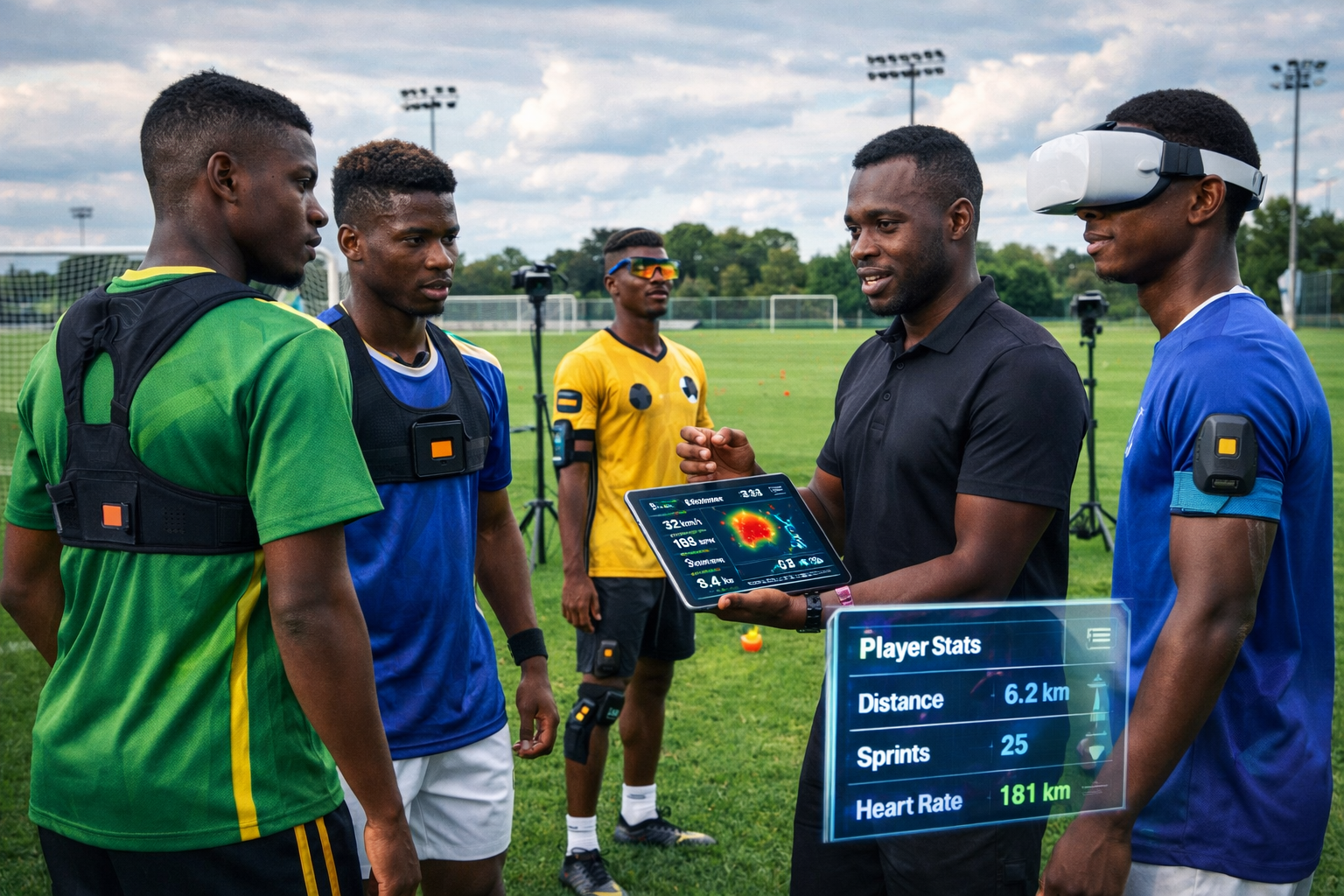
The invisible transfer nobody talks about
Every sprint, every tackle, every heartbeat spike under pressure is now worth money. Across African football academies, leagues, and national teams, athletes are no longer evaluated only by coaches and scouts. They are measured by sensors, mapped by cameras, and modelled by algorithms.
What looks like modern performance analysis is quietly becoming something else entirely: a large‑scale data extraction system, where African bodies generate high‑value datasets that rarely stay on the continent.
This is not a story about gadgets. It is a story about power, ownership, and value — and how African athletes have become the raw material in a global sports technology economy.
From performance to product
For decades, African football exported talent. Today, it exports data about talent.
Using tools marketed as innovation — Virtual Reality (VR), Augmented Reality (AR), Mixed Reality (MR), and artificial intelligence (AI) — clubs and federations are collecting unprecedented volumes of information about players:
- Movement patterns and biomechanics
- Reaction time and decision‑making speed
- Stress responses and cognitive load
- Injury risk indicators and recovery curves
This data does not disappear after training. It is stored, analysed, modelled, and often reused — long after a player is released, injured, or forgotten.
The athlete remains local. The value travels.
How the extraction works
1. Capture: when training becomes surveillance
Modern football environments are saturated with capture technologies:
- Cameras track player positioning and speed in real time
- Wearables log heart rate, load, fatigue, and recovery
- VR simulations record reaction time, decision patterns, and stress behaviour
- AR systems overlay tactical instructions while logging compliance
Players are told this is for development. What they are rarely told is how long the data lives, who owns it, or where it goes next.
2. Intelligence: when behaviour becomes prediction
Raw data alone is not valuable. AI is what converts it into capital. Machine‑learning systems analyse thousands of data points to produce:
- Injury risk scores
- Tactical obedience ratings
- Psychological resilience indicators
- Market value projections
At this stage, the athlete stops being a person and becomes a profile — a digital model designed to predict future usefulness.
These profiles influence decisions players never witness: selections, contracts, transfers, and even insurance coverage.
3. Distribution: where the value ends up
Once processed, athlete data enters a global ecosystem that includes:
- Clubs and scouting networks
- Analytics firms
- Betting and performance prediction companies
- Insurers and risk assessors
Very little of this value returns to the players who generated it.
The consent problem
Most athletes technically agree to data collection. But agreement is not the same as choice.
In many African academies and competitions:
- Contracts are signed in unfamiliar legal language
- Players are minors or economically dependent
- Refusal often means exclusion
Consent under these conditions is structural, not voluntary.
The choice is simple and brutal: submit to total measurement or lose the opportunity entirely.
Why Africa is uniquely exposed
African football sits at the intersection of three vulnerabilities:
- Weak data protection enforcement
- Economic pressure on athletes and families
- Dependence on foreign technology providers
This makes the continent ideal for large‑scale data harvesting with minimal resistance. While European players increasingly benefit from data transparency laws, African athletes often have no access to their own datasets — let alone control over resale or reuse.
A new kind of extraction economy
This system does not resemble old‑style exploitation. There are no chains, no forced movement, no visible violence.
Instead:
- Bodies stay put
- Data moves freely
- Contracts legitimise asymmetry
The result is a quiet form of extraction where value flows outward and accountability evaporates.
African football is not just developing players for the world. It is training algorithms for it.
What ethical sports technology would look like
A fair system would not reject technology. It would rebalance power.
That would include:
- Clear athlete data ownership rights
- Time‑limited data usage
- Revenue‑sharing from commercial reuse
- Player access to raw and analysed data
- Africa‑based data infrastructure
Without these safeguards, innovation becomes a cover story.
The question that remains
African athletes are told that data makes football fairer, smarter, and more scientific.
But until players can see, control, and benefit from the value their bodies generate, one truth remains unavoidable:
XR captures behaviour. AI turns it into capital. And African football pays the price
About Florsport International
Florsport International investigates African football beyond the scoreboard — documenting power, systems, and stories the global game prefers to ignore.
Leave a Reply
You must be logged in to post a comment.