
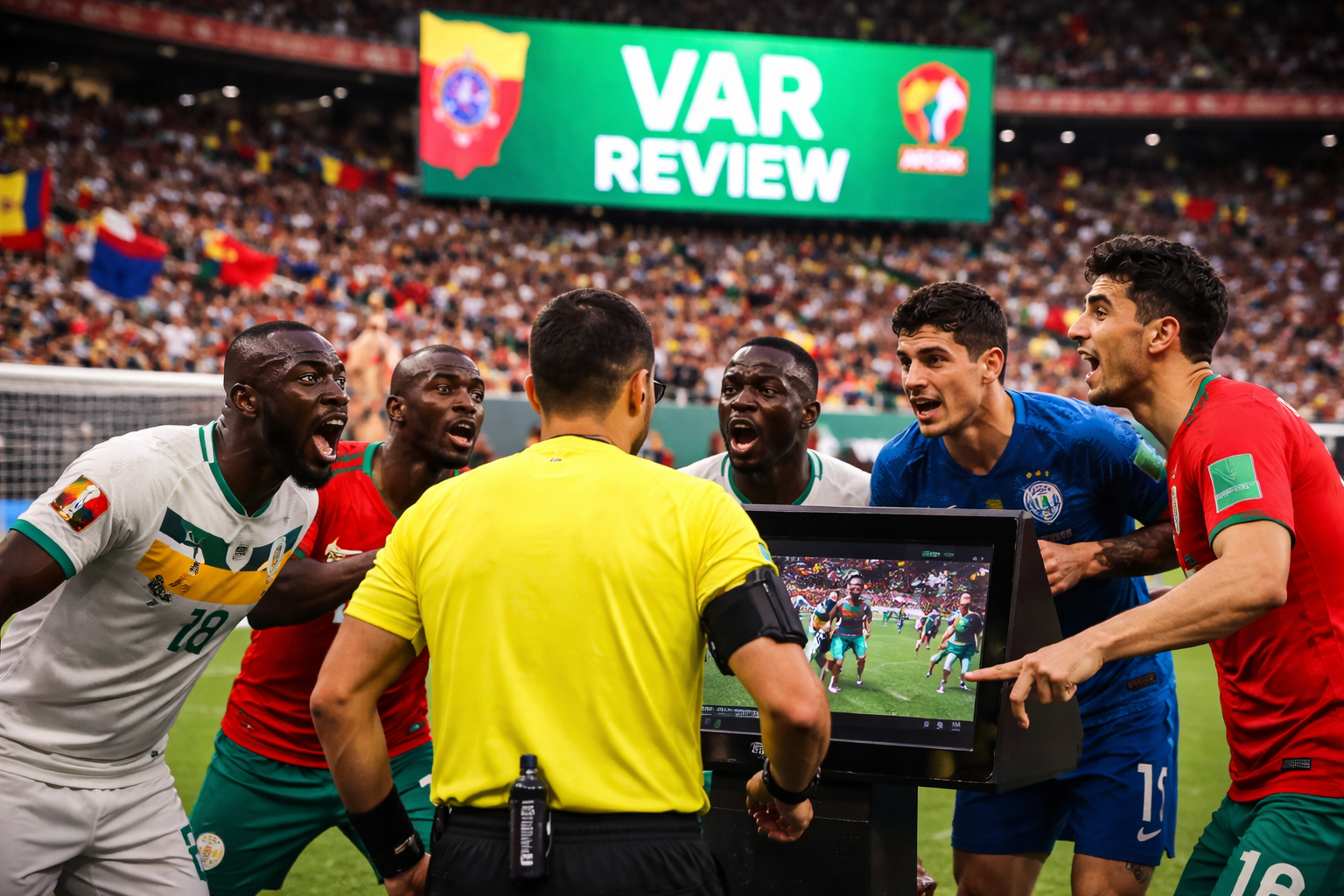
Video Assistant Referee (VAR) technology was introduced to football with a simple promise: fewer errors, greater fairness, and reduced controversy. Yet across global tournaments — from the World Cup to the Champions League — VAR has often intensified debate rather than resolved it.
African football is not unique in this experience. But at AFCON, controversies around officiating and VAR have repeatedly raised a deeper, more important question: not who benefits from individual decisions, but who defines the structures that govern them.
Why VAR Exists — and Why It Still Divides
VAR was designed to assist referees, not replace them. Final decisions remain human, shaped by interpretation, pressure, and context. Around the world, this has produced disagreement rather than consensus.
In Africa, VAR’s introduction has collided with uneven infrastructure, inconsistent training environments, and varying levels of institutional capacity. The result is not necessarily manipulation — but structural fragility, where every high-stakes decision becomes a flashpoint.
Understanding this distinction is crucial.
AFCON 2025: What Actually Happened
AFCON 2025 brought these tensions into sharp focus. Several matches — including high-profile knockout fixtures — featured VAR-assisted decisions that sparked protests from players, coaches, and fans.
In the final, a late VAR-related decision triggered extended stoppages, on-field confrontations, and post-match disciplinary actions. CAF later confirmed fines and suspensions, while also announcing an internal review of officiating standards.
These incidents were widely debated across African media, often framed as questions of fairness or bias. Yet the documented facts point to procedural breakdowns, not proven external control.
The controversy was real. The evidence of manipulation was not.
Controversy Is Not Proof of Corruption
It is tempting — and emotionally satisfying — to interpret controversial decisions as evidence of hidden influence. African football’s history makes supporters understandably suspicious.
But controversy alone does not equal corruption.
Veteran coaches, referees, and analysts have repeatedly noted that high-pressure environments amplify error, especially when officials operate within inconsistent systems. Poor communication, unclear protocols, and limited referee support explain far more than conspiracy narratives.
This matters because misdiagnosing the problem leads to the wrong solutions.
So Who Actually “Controls” the Game?
If control exists, it is institutional, not individual.
Control lies in:
- CAF’s referee selection and evaluation systems
- VAR training standards and certification
- Match-day operational protocols
- Post-match accountability mechanisms
No host nation, federation, or political actor directly controls VAR decisions on the pitch. But CAF’s governance structures shape the conditions under which decisions are made — and that is where reform must focus.
The question is not who pulls strings, but who sets standards.
The Structural Challenge Facing African Officiating
African referees operate under intense scrutiny, often without the layered institutional support common in Europe or South America. Limited access to continuous training, inconsistent exposure to elite competitions, and uneven technological infrastructure compound pressure.
VAR magnifies these weaknesses. Technology does not correct institutional gaps — it exposes them.
Without investment in referee development, clearer communication protocols, and transparent review systems, VAR risks becoming a lightning rod rather than a solution.
CAF’s Response — and Its Limits
CAF has acknowledged these challenges, introducing:
- Expanded VAR training programs
- Referee rotation policies
- Internal performance reviews
These steps are important but incomplete. Without public transparency, standardized enforcement, and long-term referee pathways, reforms struggle to earn trust.
Credibility is built slowly — and lost quickly.
AFCON 2027 represents a critical opportunity. Not to eliminate controversy — football will always have it — but to reduce structural uncertainty.
That requires:
- Clear VAR communication standards
- Transparent officiating reviews
- Investment in referee education equal to player development
- Institutional accountability, not public scapegoating
African football does not need fewer debates. It needs stronger systems that can withstand them. VAR did not introduce controversy to AFCON. It simply made existing weaknesses visible.
What happens next will determine whether African football learns — or repeats itself.
Leave a Reply
You must be logged in to post a comment.