
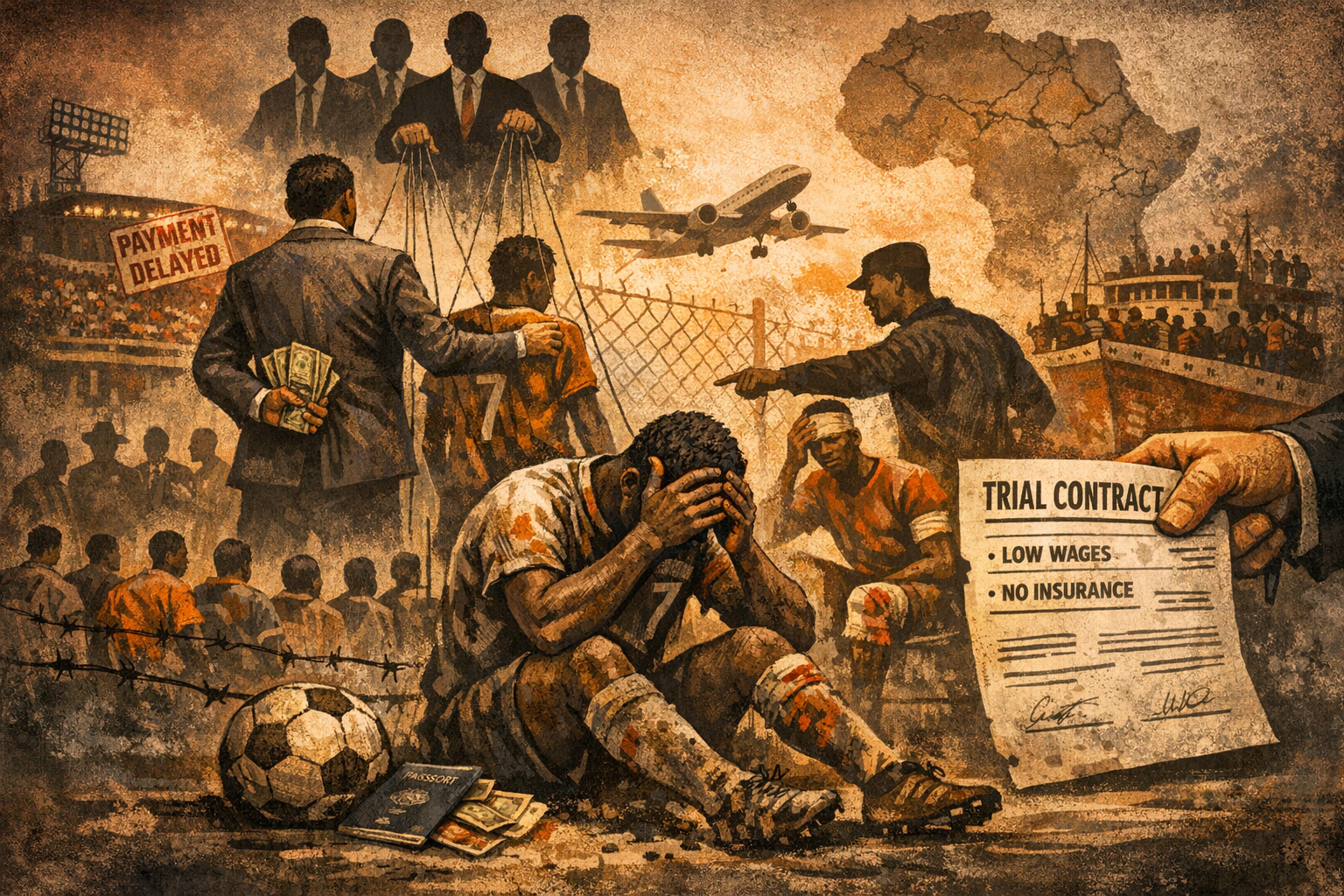
African footballers are among the most technically gifted, physically dominant, and mentally resilient players in the world.
They adapt quickly.
They endure pressure.
They survive unstable systems.
Yet the question remains uncomfortable and unresolved:
Does this resilience make African players the easiest football labour force to exploit?
This editorial does not romanticise struggle. It examines how global football has learned to profit from African endurance without accountability.
RESILIENCE AS A RESOURCE, NOT A VIRTUE
In modern football, resilience is no longer just admired.
It is priced.
African players are recruited not only for talent, but for:
- Willingness to endure uncertainty
- Acceptance of delayed wages
- Ability to play through pain
- Silence in the face of abuse
What is praised as “mental toughness” often functions as risk absorption.
If a player can endure bad conditions and still perform, the system has no incentive to improve those conditions.
REAL-WORLD FORMS OF EXPLOITATION
1. Trafficking disguised as opportunity
Across multiple regions, young African players are:
- Promised trials in Europe, Asia, or the Middle East
- Charged illegal “processing fees”
- Transported without proper contracts
- Abandoned when trials fail
Many end up:
- Undocumented
- Stranded
- Working menial jobs
- Or returning home in debt and silence
This is not rare. It is systemic.
2. Delayed or unpaid wages
In parts of:
- North Africa
- East Africa
- Central Africa
Players routinely go months without pay, while:
- Leagues continue
- Clubs register new players
- Officials collect allowances
Foreign African players are especially vulnerable — they fear contract termination, deportation, or blacklisting.
3. Short-term contracts, long-term risk
African players are disproportionately offered:
- One-year contracts
- Performance-heavy clauses
- Minimal injury protection
An injury can end a career instantly — with no insurance, no rehabilitation, no settlement.
4. Physical extraction, tactical exclusion
African players are often recruited for:
- Strength
- Pace
- Pressing
But excluded from:
- Playmaking roles
- Leadership pathways
- Long-term team-building
They are used intensely, rotated quickly, and replaced cheaply.
WHICH PARTS OF AFRICA ARE MOST NOTORIOUS?
This is not about blame — it’s about patterns.
West Africa
Countries like Nigeria, Ghana, Ivory Coast, Senegal are major talent exporters.
Problems:
- Unregulated academies
- Agent-driven recruitment
- Early migration
- High drop-out rates abroad
High volume creates low individual protection.
Central Africa
Countries like Cameroon, DR Congo face:
- Weak domestic leagues
- Political instability
- Heavy reliance on foreign agents
Players are often moved without strong federation oversight.
North Africa
More structured leagues, but:
- Wage disputes
- Contract manipulation
- Player registration traps
Sub-Saharan Africans playing in North Africa report:
- Lower pay than locals
- Limited legal recourse
- Cultural and racial marginalisation
East Africa
Kenya, Uganda, Tanzania face:
- Semi-professional conditions
- Weak player unions
- Poor contract enforcement
Players are exploited domestically before even thinking about Europe.
WHO ARE THE CULPRITS?
1. Rogue agents and intermediaries
Often:
- Unlicensed
- Former players
- Community-connected
- Untouchable locally
They operate on hope, not contracts.
2. Clubs
Both African and foreign clubs that:
- Delay wages
- Ignore contracts
- Terminate players arbitrarily
- Use “trial culture” to avoid responsibility
3. Football federations
When federations:
- Fail to enforce contracts
- Protect clubs over players
- Ignore FIFPRO standards
They become silent accomplices.
4. Families and communities
Uncomfortable but real:
- Pressure to “make it”
- Willingness to sell land or borrow money
- Unrealistic expectations
Hope becomes leverage.
WHY AFRICAN PLAYERS DON’T FIGHT BACK
Because the cost is high:
- You get labelled “difficult”
- You lose future opportunities
- You risk deportation
- You burn bridges in small football markets
Silence is often a survival strategy.
WHAT MUST PLAYERS DO TO AVOID EXPLOITATION
This is not victim-blaming.It is survival literacy.
1. Never move without a written contract
No contract = no protection.
Trials without:
- Duration
- Accommodation
- Transport
- Return clause
are red flags.
2. Verify agents
- Demand license numbers
- Cross-check with federation
- Avoid agents who charge players upfront
Real agents get paid by clubs.
3. Use player unions
Even weak unions offer:
- Legal advice
- Documentation
- Emergency intervention
Isolation is the exploiter’s advantage.
4. Delay migration
A stronger domestic profile:
- Improves bargaining power
- Reduces desperation
- Increases options
Early exit often equals early vulnerability.
5. Document everything
Contracts. Messages. Payments. Promises.Paper trails are power.
THE CORE TRUTH
African players are not exploited because they are weak.
They are exploited because they are:
- Talented
- Replaceable
- Resilient
- And under-protected
Football has learned that African endurance lowers the cost of injustice.
The question is no longer:
“Can African players endure hardship?”
The real question is:
Why does global football still demand it?
Until African footballers gain:
- Strong unions
- Enforced contracts
- Ethical migration pathways
- Narrative control
Resilience will continue to be mistaken for permission.
And exploitation will continue to wear the mask of opportunity.
Leave a Reply
You must be logged in to post a comment.