
Beyond the goals, a greener game is being built. This is the story of the first climate-conscious AFCON.
Let me be clear: I didn’t come to Morocco just for the football. I came for the quiet revolution happening behind the scenes. As the 2025 Africa Cup of Nations approaches, a bold question hangs in the air: Can a continent bearing the brunt of the climate crisis host a football festival that doesn’t cost the earth?
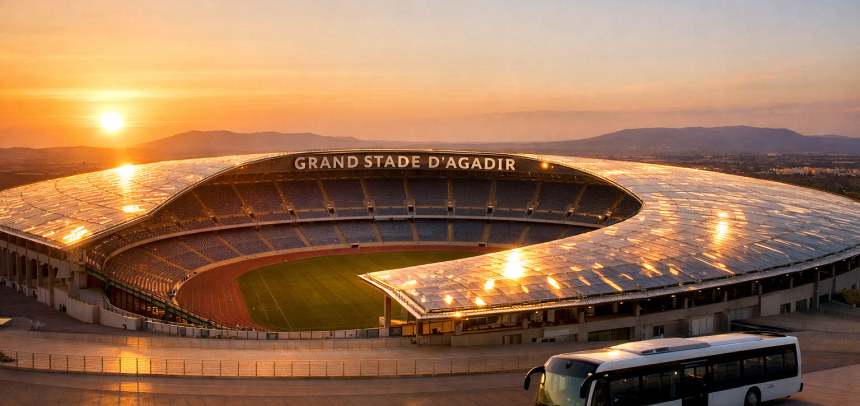
Morocco’s answer isn’t just a whisper; it’s a blueprint. From the moment I landed, the mission was tangible. My taxi wasn’t headed for a generic hotel, but toward the Grand Stade d’Agadir, a colossus where the roar of the crowd will soon be matched by the silent hum of its vast solar canopy.
“This isn’t a stadium; it’s a power plant that hosts football matches,” engineer Layla Benali told me, her hand shading her eyes as she gazed at the panels. “On match day, we’ll power the floodlights with the North African sun that baked them hours before. The surplus feeds back into the city’s grid. It’s a closed loop.”
But the most profound shift isn’t in the infrastructure—it’s in the mindset. I sat down with Morocco’s visionary coach, in a meeting room lit by natural light. “We talk about pressing traps and defensive lines with the players,” he said, leaning forward. “Now we also talk about legacy. We tell them, ‘You are not just playing for a trophy; you are playing in a tournament that aims to set a new standard.’ That pride is a different kind of fuel.”
The Green AFCON is a mosaic of such innovations. At the training pitch in Rabat, the groundskeeper, Karim showed me the sub-surface sensors. “Every drop of water is accounted for,” he explained, kneeling in the pristine grass. “We use 40% less than a conventional pitch. In a water-stressed region, that’s not an option. It’s an obligation.”
The fans are part of the pact. At a local café in Marrakech, supporter Yasmina El-Kouri showed me her digital tournament pass. “They incentivize using the new electric tram system with reward points,” she said, her phone flashing. “Even the souvenir vendors are using biodegradable materials. It makes you feel like you’re part of the solution, not just a spectator to the problem.”
Skeptics will ask: Is this enough? Can electric buses offset the carbon from flying 24 teams across a continent? “This is not about being perfect on Day One,” he told me firmly. “It’s about proving it’s possible. It’s about creating a template that Dakar or Nairobi can adapt and improve in 2027. We are building the first draft of a sustainable football future.”
As the sun set over the Atlas Mountains, turning the sky orange, I understood. The true victory of AFCON 2025 won’t be measured only in goals saved, but in kilowatts generated, liters of water preserved, and a powerful idea planted: that the beautiful game has a responsibility to protect the world that celebrates it.The whistle is about to blow on a new kind of tournament. And I, for one, can’t wait to watch it grow.